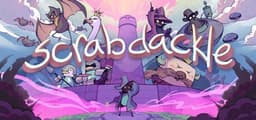
Bottom Line: Scrabdackle is a confident, hand-animated Zelda-like with fast, demanding wand combat and a world dense with lore. Two-thirds of it doesn't exist yet. Act 1 alone justifies buying in, as long as you can accept a story that won't finish for years.
The Gameplay Loop: Learn, Unlock, Prove
Scrabdackle's core loop is old and still works: you find a spell, the map opens up, and you take the new ability into a fight that asks you to master it. What keeps it from feeling like a checklist is that the spells aren't single-purpose keys. In a lazier Metroidvania, the grappling hook opens grappling-hook doors and does nothing else. Here, a spell is a traversal tool, a puzzle solution and a combat verb all at once. Learning it in one context makes you better in the other two.
That overlap lets the game be stingy with abilities and still feel varied. Six spells sounds like a small number. In practice, combining them across exploration, puzzles and fights gives the toolkit more depth than the count suggests, and that's a smarter design choice than flooding you with abilities you'll forget about by hour ten.
Combat: Fast, Precise and Not Forgiving
Players and previewers keep landing on the same comparison: classic Zelda crossed with twin-stick shooters like The Binding of Isaac. That's accurate, and it tells you what Scrabdackle is really asking for. The wand combat is fast and precise, built around aim, spacing and reading enemy patterns rather than mashing a sword button. The Souls-like influence shows up in the bosses, which are framed as exams on what you've learned rather than damage sponges.
That gives the game a real identity, and it will also turn some people away. A hand-drawn storybook look suggests a gentle experience, and the combat often isn't one. Anyone who arrived for the illustrations and found themselves dying to a boss on the fourth attempt could feel misled by the art direction.
The difficulty settings, and "Poet" mode in particular, are what keep this from being a design flaw. Poet mode explicitly puts exploration ahead of combat. That's an honest admission that a large part of this audience wants the world more than the fights. Adjustable difficulty in a Souls-adjacent game still draws pointless arguments online, so offering it plainly is the right call, and it widens the audience a lot.
Exploration: The World Is the Product
Freedom to wander is one thing. Having something worth finding is another. Scrabdackle has both. The numbers are large: 80,000+ words of writing, 130+ notebook entries, 60+ hidden collectibles and challenges. For comparison, 80,000 words is the length of a full novel, and one person wrote it alongside drawing, animating, coding and designing.
That density is why the non-linear structure pays off. Open worlds without much content teach you to stop looking around. Scrabdackle seems to teach the opposite: corners are worth checking, characters are worth talking to, and the notebook is worth filling in. The whimsical tone that previewers keep mentioning shows up in this writing, and it's the main reason the world feels lived-in rather than generated.
There is a risk. 80,000 words is a lot of reading, and lore-heavy games often confuse volume with depth. Notebook entries can turn into homework, and unskippable chatter wears thin on a third pass through a region. If dialogue pacing or lore delivery is going to cause friction anywhere, it will be here, and Act 1 is too early to say whether the writing holds up over 40 to 50 hours.
The Early Access Problem
This is where you have to be skeptical. Only Act 1 of 3 is available. That act is substantial, but Scrabdackle is still an unfinished story with a two-year roadmap, and it comes from a solo developer. Solo projects run late. That isn't a criticism of jakefriend; it's simply what happens when one person carries the art, code, design and writing for a 40-to-50-hour game.
What we don't know yet: how the free updates will handle save continuity, whether later acts will rebalance Act 1's systems, and how the full spell and boss list is split between acts. The headline numbers (six spells, nine bosses, 10 to 11 regions) describe the whole game, and the store copy doesn't say clearly how much of each ships in Act 1. If you're buying for the complete package, you're buying a promise.
The mitigating factor is real, though: 12 to 18 hours for Act 1 is more than many finished indie games offer. Even if Acts 2 and 3 slip, what you're paying for today is a complete, satisfying chunk of play, not a vertical slice.