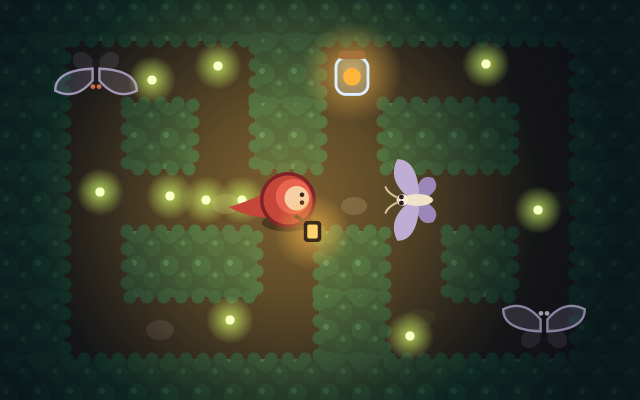
Bottom Line: Leo's Fortune is still one of the best-made physics platformers ever built for touch screens: beautiful, tightly tuned, and confident in what it is. It is also short, and in its last act it slips into trial-and-error. Play it with a gamepad if you can.
The Gameplay Loop
The core idea of Leo's Fortune is that your character's shape is your controller. Leo doesn't jump in the usual sense. He inflates, and the extra air lifts him the way a balloon rises. Deflating makes him dense, fast and destructive. The whole game comes from switching between those two states while rolling, so you are always managing mass and momentum.
It's a simple system with real depth. Early levels teach each move on its own: glide across this gap, smash through this floor. By the middle of the game the levels ask for combinations. You roll down a slope to build speed, puff up at the lip to carry the momentum into a glide, then deflate mid-air to drop through a breakable platform just before a saw blade sweeps past. When a sequence like that works, it feels like one continuous motion rather than a string of button presses. Few platformers of any era manage that.
Pacing is where the design shows its discipline. Traversal and puzzles alternate. A fast descent through a collapsing mine leads into a quieter room where you balance two platforms with a crate. That rhythm keeps the 24 levels from feeling repetitive, even though Leo never gains a new ability. The game never adds power-ups or upgrades. Levels get harder by recombining the three moves you already have, and it works because those moves were tuned so carefully from the start.
Where It Stumbles
The last stretch of the campaign is the weak spot. In the final chapters the game replaces readable challenge with memorization. Some traps can only be avoided once they've already killed you: a crusher timed to an off-screen trigger, or a platform that gives way with no warning. The checkpoints are generous enough that frustration rarely turns into quitting. Still, a game this concerned with fairness in its first two-thirds shouldn't depend on surprise deaths near the end. The Steam and App Store feedback says the same thing, and it matches my own read.
Physics causes a smaller problem too. When a puzzle depends on stacking or balancing objects, the simulation sometimes lands in a state the designers clearly didn't plan for: a crate wedged at an odd angle, or a weight that won't settle. It doesn't happen often, but when it does you have to restart from the checkpoint and redo the setup.
Replay Value and the Length Question
A first playthrough takes a few hours. That is the most common criticism, and I won't pretend it isn't. The game's answer is depth over breadth. The three-star system makes each level three separate challenges, and they conflict with each other. A speed run pushes you to skip coins, while collecting every coin means exploring side paths that cost time. Leaderboards give speedrunners something to chase.
Hardcore Mode is the most serious test. Clearing all 24 levels without a single death requires full mastery of the movement system, and it brings back those late-game trial-and-error deaths as run-ending hazards. It's hard and a little cruel, and it isn't for everyone. For players who got hooked on the physics, it roughly doubles the game's lifespan.
Narrative Framing
Platformer stories are usually an afterthought. Leo's Fortune treats its story as part of the game's character. The narrated chapter breaks play like a picture book being read aloud, with dry, gentle humor, and they give Leo's chase a slightly neurotic edge. The ending recasts what came before and gives the chase a meaning it didn't seem to have. It takes only a few minutes in total, but it gives the game more emotional weight than a mustachioed fuzzball should have.